
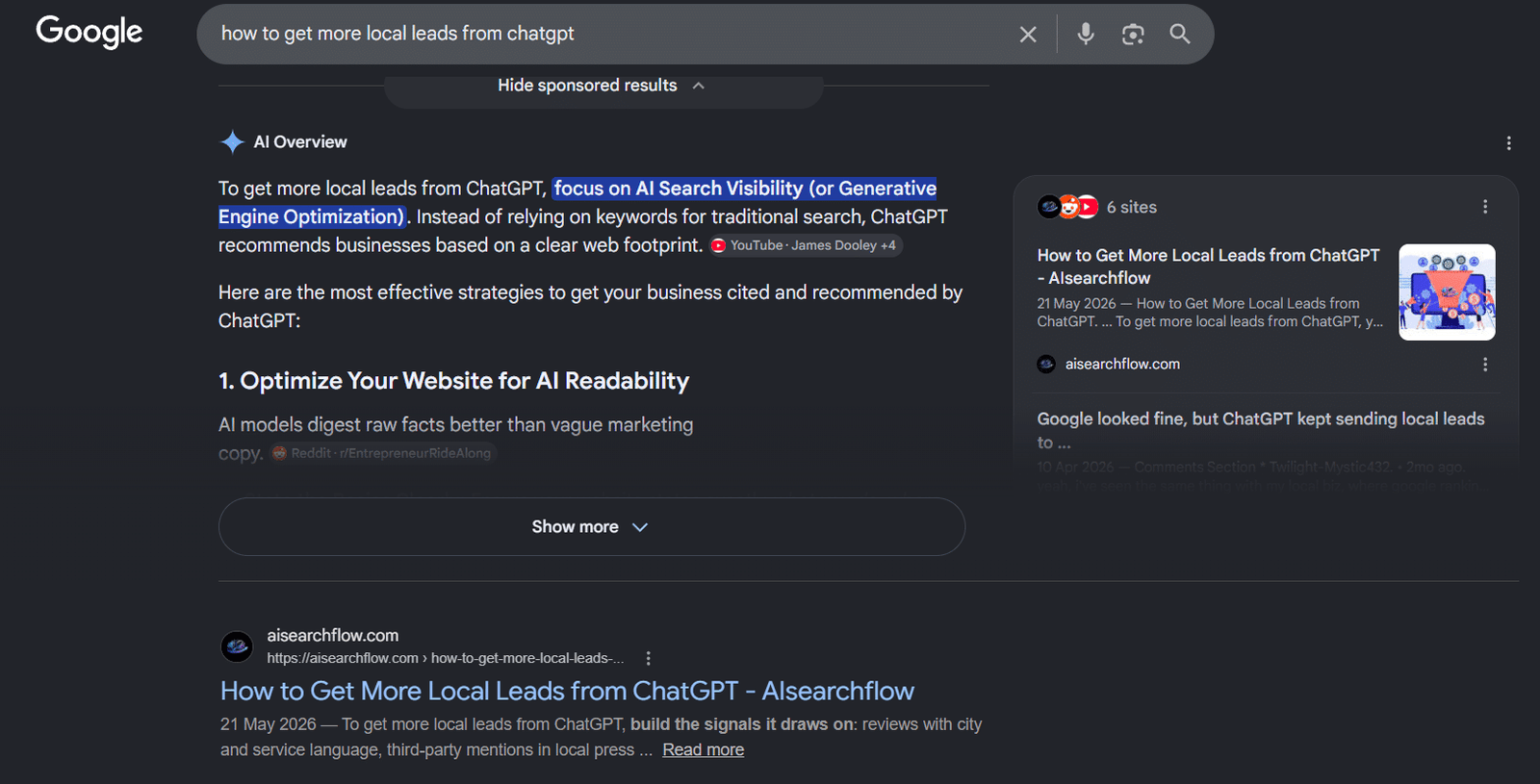
To get your business listed in ChatGPT and AI Overviews, you need consistent business information across the web, third-party validation through reviews and mentions, content that answers customer questions directly, and a website AI crawlers can actually read. There’s no submission form. AI models pull your business into an answer because they found you described the same way in enough trustworthy places to confirm you’re real and relevant.
If you run a local service business, here’s what each of those four things looks like in practice.
Key takeaways
-Match your business name, address, and phone number across every listing.
-Get reviewed and mentioned on sites other than your own.
-Write pages that answer specific customer questions in the first few sentences.
-Add author bios and real photos so AI can confirm a real business is behind the page.
-Make sure AI crawlers can actually load and read your site.
Fix your Google Business Profile first
AI Overviews pulls heavily from Google’s own index, including Business Profile data. If your hours are wrong, your category is vague, or your profile has five photos from 2019, you’re giving the system bad inputs. Set your primary category to match exactly what you do. “HVAC contractor” beats “Contractor.” Fill in services, service area, and attributes completely. Keep hours current, especially around holidays. This is the fastest fix on this list and the one most local businesses skip.
Get named the same way everywhere
AI models check whether your business name, address, and phone number match across directories before trusting a mention. If Yelp says “Martinez Plumbing LLC” and your website says “Martinez Plumbing Co.” and your Facebook page says “Martinez Plumbing,” that’s three different entities to a model trying to confirm who you are. Pick one name format. Use it on your website, Google Business Profile, Yelp, Facebook, Apple Maps, and every directory listing you control. Update the old ones instead of creating new profiles.
Get mentioned on sites AI models already trust
ChatGPT and AI Overviews lean on third-party sources to validate claims about a business: review sites, local news, industry directories, and forums like Reddit. A glowing paragraph on your own homepage carries less weight than a mention on Yelp or a local Facebook group recommendation. Three sources worth prioritizing for a local business: industry-specific directories (HomeAdvisor for contractors, Avvo for lawyers, Healthgrades for medical), local news or community sites, and review platforms with detailed text reviews, not just star ratings. Detailed reviews give the model language to pull from when answering “who’s good at X near me.” If you want to see what AI models say about you right now, LLM SEO analysis software will show you which sources are already feeding answers about your brand.
Show a real business is behind the page
A page with no author, no photos, and no contact details past a form gives AI nothing to verify. Add a bio for whoever writes your content, with their actual role at the company. Use real photos of your team, your work, or your location instead of stock images. Link to your reviews instead of just claiming “we’re trusted.” This matters more for service categories where trust is a factor in the buying decision: medical, legal, home repair, financial. A roofer with three case studies showing before-and-after photos and a named project lead is easier for a model to cite than a roofer with a paragraph of marketing copy.
Answer the exact question your customers ask

AI Overviews and ChatGPT favor content that states something plainly instead of building up to it. If someone asks “how much does a water heater replacement cost in Austin,” a page with that exact answer in the first two sentences gets pulled before a page that opens with three paragraphs about the history of water heaters. Write a dedicated FAQ page or section for your most common customer questions. State the answer first. Add the explanation after. Use the customer’s actual phrasing, not internal jargon. Mark up the FAQ section with FAQPage schema so the structure is explicit, not just visually implied by headings. For a fuller walkthrough of how to organize this kind of content, see how to structure your content to get AI to cite your brand.
Make sure your site can actually be read
Some AI crawlers are stricter than Google’s. If your pricing or service details load only through JavaScript, or your robots.txt blocks GPTBot or ClaudeBot, none of the above matters because the crawler never sees the page.
Check your robots.txt file for blocks on AI crawlers. Confirm your key pages (services, pricing, contact) render without JavaScript, or at least render the core content server-side. Add Organization or LocalBusiness schema so your name, address, phone, and services are machine-readable, not just visible to humans.
People also ask
Can my business actually rank in an AI Overview the way it ranks on Google?
No. AI Overviews pulls from pages that already perform well in organic search and combines several into one answer. There’s no separate ranking position to chase. The path is the same strong content and technical SEO that gets you ranking, paired with an answer-first structure.
Does ChatGPT work the same way as AI Overviews?
Not exactly. ChatGPT generates a more conversational response and decides in the moment which sources to treat as credible enough to cite. Being included depends more on whether your content reads as a trustworthy, specific source than on holding any particular search position.
Do customer reviews actually affect this?
Yes. Reviews are one of the clearest third-party signals AI models use to confirm a business is real and worth recommending. A business with detailed, specific reviews on Yelp or Google is easier to cite than one with only a handful of generic five-star ratings.
How long does this take to show results?
There’s no fixed timeline. It depends on how inconsistent your current listings are and how thin your existing content is. Businesses starting from a messy NAP and no FAQ content typically see initial citations build over a few months, not weeks.
Conclusion
None of this is about gaming an algorithm. It’s about giving AI models consistent, confirmable facts about your business from multiple independent sources, the same way a person decides whether to trust a recommendation. For the full breakdown of how AI visibility works beyond ChatGPT listings, including AI Overviews, Perplexity, and Gemini, see complete guide to AI Search Visibility for Businesses in 2026.
Leave a Reply