
Key takeaways
AI search engines don’t recommend “the best business.”
They recommend the best-represented business in the data.
AI-powered search now recommends businesses based on strong data, quality reviews, and accurate profiles, not just traditional SEO tricks. To boost your visibility, you must update your business details everywhere, gather positive reviews, and track your results regularly.
Key points:
- AI tools highlight businesses with high ratings, up-to-date profiles, and consistent data across platforms.
- AI platforms use user history and preferences to personalize recommendations, rewarding businesses that match real customer needs.
- Simple errors like outdated hours or missing photos can quickly drop your ranking in AI search.
- Ongoing review gathering, data accuracy, and quick response to changes are key to staying ahead.
- Smaller businesses can still win by adapting quickly and using targeted optimization strategies.
| Topic | Key Insight | Why It Matters | Action Item |
|---|---|---|---|
| AI Search Visibility | AI recommends businesses with strong ratings, detailed profiles, and clear data | These factors directly influence whether AI suggests your firm | Audit and improve your online profiles everywhere |
| Review Quality | High average ratings and honest customer responses boost AI visibility | Even a small ratings bump can make a business show up | Encourage and manage detailed, positive reviews |
| Profile Completeness | Missing info makes AI skip your business | Incomplete data hurts trust and discoverability | Fill in all categories, hours, and update photos |
| Data Accuracy | Outdated or inconsistent info gets penalized by AI | Consistency signals legitimacy across platforms | Sync your hours, addresses, and offerings |
| Adapting to Algorithms | Platforms change often, so regular audits are needed | Staying current prevents sudden drops in search ranking | Monitor AI search visibility and rival performance |
| Fairness in AI | No secret bias—AI rewards those best represented in the data | Small businesses can outpace larger ones with strong metrics | Focus on entity strength and quick profile updates |
Business owners ask this almost daily. Why is the AI giving their customers to someone else? Here’s the reality: AI-powered search tools are changing the way people discover businesses. Clearer, more data-rich competitors win the spotlight even if your service is top-notch. If you want to boost your AI search visibility, you need to understand how AI-generated recommendations really work, and what makes these algorithms choose one business over another. Learn more with data based article why businesses are invisible in AI Search?
How do AI systems choose which businesses to recommend?
AI selects businesses using structured data, review sentiment, profile completeness, and cross-platform consistency not keywords or backlinks.
Traditional SEO ranks pages.
AI recommendation systems rank entities.
AI search visibility means more than just appearing in Google results. For a deeper dive, check out our article AI Search Visibility in 2026: How to Make Your Business Appear on AI. Tools like ChatGPT and Perplexity use advanced language models and data graphs to match users with businesses that best fit the “ideal answer” based on their criteria not yours. Unlike traditional SEO, where keyword stuffing and backlinks might push you up the ranks, AI-generated recommendations are all about rich data, ratings, and context.
AI tools prioritize:
- Businesses with higher ratings and more positive reviews
- Profiles that are filled out, verified, and regularly updated
- Accurate, up-to-date business information
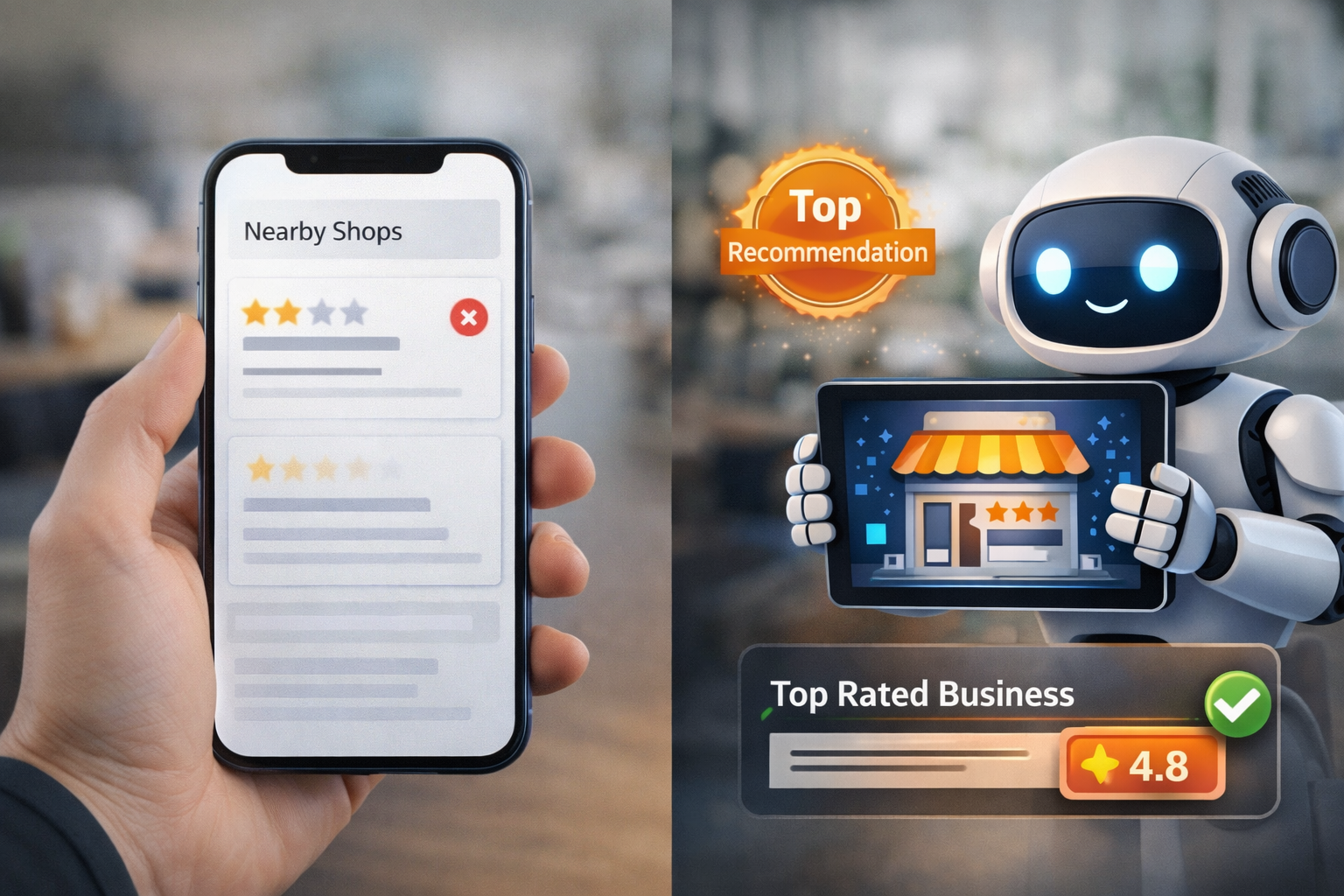
For example, while traditional search might show nearby options with so-so ratings, AI recommendation criteria cut out those with weak signals. That means even if you’re the closest or oldest shop in town, you might get skipped. Entity SEO is the concept here: AI systems look for clear, well-defined “entities” (like your business) instead of just keywords.
What factors most influence AI business recommendations?
AI recommendations depend on ratings, review sentiment, profile completeness, data accuracy, and how well an entity matches user intent.
The answer is in the data. AI search visibility depends on how well your business lines up with what AI systems value. How to increase visibility in ChatGPT searches?
How important are ratings for AI business recommendations?
Most AI systems exclude businesses below roughly 4.1–4.3 stars, making even small rating gaps the difference between visibility and omission.
AI doesn’t average sentiment like humans do.
It filters first.
AI chooses businesses based on who has the best customer responses, not just those with many reviews. Most AI-generated recommendations use a threshold often 4.1 to 4.3 stars on average to filter out average or risky options. Why? Because that’s what builds trust with end users. Studies show that even a 0.2-star difference can mean more exposure or total omission from AI results.
Why does profile completeness affect AI visibility?
Incomplete profiles reduce AI confidence, causing systems to skip businesses missing hours, categories, photos, or service details.
If your profile is missing hours, categories, or recent photos, you’re not helping the AI. AI recommendations love:
- Detailed locations, business categories, and services
- Updated images and verified hours
- Service area accuracy
When Liberty Tax improved their online profiles, their AI recommendation rates jumped from 7% to over 19% without any major marketing push (Search Engine Land report).
How does data accuracy impact AI search rankings?
AI penalizes inconsistent hours, addresses, and categories across platforms because inconsistency signals higher risk and lower trust.
Correct labeling and cross-platform consistency matter. The AI needs to be sure your business is “real” and still open. That means syncing your hours, categories, and addresses everywhere. Outdated data will push you down every time.
How does personalization influence AI recommendations?
AI personalizes recommendations using user history, preferences, and constraints, favoring businesses that align with past behavior and needs.
Each user sees results customized to their history and needs. If your business matches previous user interests (vegan options, flexible hours, deals), you’ll show up more. If not, you’ll quietly disappear. Think about what actually matters to your real customers not just generic keywords.
Do AI platforms favor their own business goals?
AI platforms optimize for user satisfaction and platform goals, prioritizing businesses that minimize risk and maximize predicted success.
AI platforms can favor user happiness or profit. Algorithms sometimes “self-preference,” meaning they promote businesses that meet their own criteria. Sometimes it’s user ratings. Sometimes it’s profit (like higher-margin options). Your job is to hit all possible signals AI looks for (Foster research).
How do industry leaders increase AI recommendation rates?
Top-performing businesses actively manage reviews, update profiles frequently, and treat data accuracy as an ongoing operational task.
Let’s get specific. What are industry leaders doing that gets them more AI search visibility?
- Restaurants: A popular chain with strong ratings and up-to-date profiles saw 30–46% recommendation rates in AI systems. These businesses didn’t just wait for customers. They gathered reviews, updated menus and photos, and responded quickly to feedback.
- Financial Services: Companies like Liberty Tax focused on data accuracy and positive sentiment. After enhancements, they outperformed the industry with nearly 1 in 5 recommendations, proving that methodical, data-driven changes really do work (Search Engine Land report).
At AIsearchflow, we help clients follow these exact strategies. Recently, a client in local retail gained a 27% improvement in AI search visibility by focusing on review quality and syncing business info across platforms. It wasn’t magic. It was data and knowing how AI chooses businesses.
How is AI recommendation ranking different from traditional SEO?
Traditional SEO ranks pages by keywords and links, while AI ranks businesses by entity strength, sentiment, and real-world trust signals.
AI vs traditional SEO is like chess vs. checkers. Both are about strategy, but the rules (and outcomes) are different.
- Traditional SEO: Focuses on keywords, backlinks, and website structure. You get ranked based mostly on what’s on your website and who links to you.
- AI Recommendation Criteria: Looks at structured data, entity strength, sentiment in reviews, completeness, and accuracy across multiple sources. It asks if you’re the “best answer” for a specific user right now.
Here’s the key: SEO can help you appear in search results, but AI search visibility depends on how well your business “looks” to the machine not just to Google, but to every AI platform.
Even perfectly optimized SEO pages can fail if the structured signals and real-world ratings aren’t strong. That’s why AI-generated recommendations matter. They reflect true user consensus, not just clever web tricks (Schema ).
What practical steps improve AI business visibility fastest?
The fastest AI visibility gains come from improving ratings, completing profiles, fixing data inconsistencies, and monitoring competitors weekly.
Ready to win back those customers? Here’s what we recommend at AIsearchflow, for every business owner, every time:
- Gather more and better customer ratings. Ask satisfied clients to leave honest, detailed reviews. Manage negative sentiment with direct responses and issue resolution.
- Complete and update your profiles everywhere (Google Business, Yelp, Apple Maps). Add new categories, photos, and service details. Make sure all data matches exactly.
- Check your competition. Benchmark against the ratings, profile strength, and visibility of your top competitors.
- Fix data errors fast. Wrong hours, old addresses, or missing attributes can drop your AI search visibility overnight.
- Track, audit, and adapt. Algorithms change. Monitor your ranking and sentiment weekly, not yearly. Read more on how to audit for AI visibility
- Consider AI business optimization strategies with experts. Platforms like AIsearchflow automate audits, highlight gaps, and guide you through specific AI recommendation criteria for all major platforms.
Business optimization is no longer set-and-forget. If you want to know how AI chooses businesses, you need ongoing analytics, competitor tracking, and a willingness to update fast.

The Role of Algorithmic Fairness in AI Recommendations
Is the AI biased? Unlikely. Most AI-generated recommendations reflect what’s actually in the data and their platforms’ priorities. There is no secret “favoritism.” If your competitor looks better on paper and in reviews, that’s who wins.
But there’s some good news: smaller businesses can use AI business optimization strategies to punch above their weight. By focusing on entity strength, review quality, and profile coverage, even new entrants can climb AI rankings. This evens the playing field and lets those who adapt fastest win more customers.
FAQs on AI Business Recommendations
How to make AI recommend your business?
Focus on five key areas: optimize your website for mobile and speed, create content that answers customer questions, get featured in respected publications, encourage detailed customer reviews, and keep your business information identical across all platforms.
How do I get ChatGPT to recommend my company?
Make sure your profile is complete, accurate, and regularly updated. Include detailed business categories, hours, photos, service areas, and links to your website. Encourage customers to leave honest, detailed reviews; these get picked up in structured data and help reinforce credibility.
Which AI technique is most commonly used for business recommendation systems?
Collaborative filtering is a technique used in recommendation systems to make predictions about an individual’s preferences based on the preferences of similar users. The idea behind collaborative filtering is that people who have similar preferences in the past are likely to have similar preferences in the future.
Why can AI bias hurt your business?
Business impacts: Bias in AI systems can lead to flawed decision-making and reduced profitability. Companies may suffer reputational damage if biases in their AI tools become public, potentially losing customer trust and market share.
How to avoid bias when using AI?
To eliminate bias, you must first make sure that the data you’re using to train the algorithm is itself free of bias or that the algorithm can recognize bias in that data and bring the bias to a human’s attention.
Conclusion: How do you stop losing customers to AI-recommended competitors?
Businesses win AI visibility by treating ratings, data accuracy, and profile completeness as ongoing assets not one-time tasks.
You have the power to stop losing customers to your competitors in AI search. Start by looking at your ratings, sentiment, and data accuracy. Update your business profiles everywhere and encourage honest reviews. Benchmark your efforts against those at the top—then do better.
And if you want an expert partner who can guide, audit, and optimize your AI presence, AIsearchflow is here for you. We help businesses like yours unlock the AI search visibility you deserve.
Don’t let old habits keep you back. The AI-driven search world rewards those who act quickly, measure often, and adapt smartly. Ready to tip the scales in your favor? The time for change is now.
Leave a Reply