
Which AI SEO Prompts Are Most Likely to Get Your Content Cited?
AI tools like ChatGPT, Perplexity, and Gemini consistently favor structured, authoritative, and community-validated content — these are the formats most likely to get cited.
AI search tools don’t rank pages anymore. They synthesize answers. ChatGPT, Perplexity AI, and Google Gemini pull from sources they trust and stitch together a response, your content either makes the cut or it doesn’t.
So what actually gets cited? I tested 50 prompts across SEO, AI marketing, productivity, and local services to find out. Here’s what the data shows.
What Makes Content Citable?
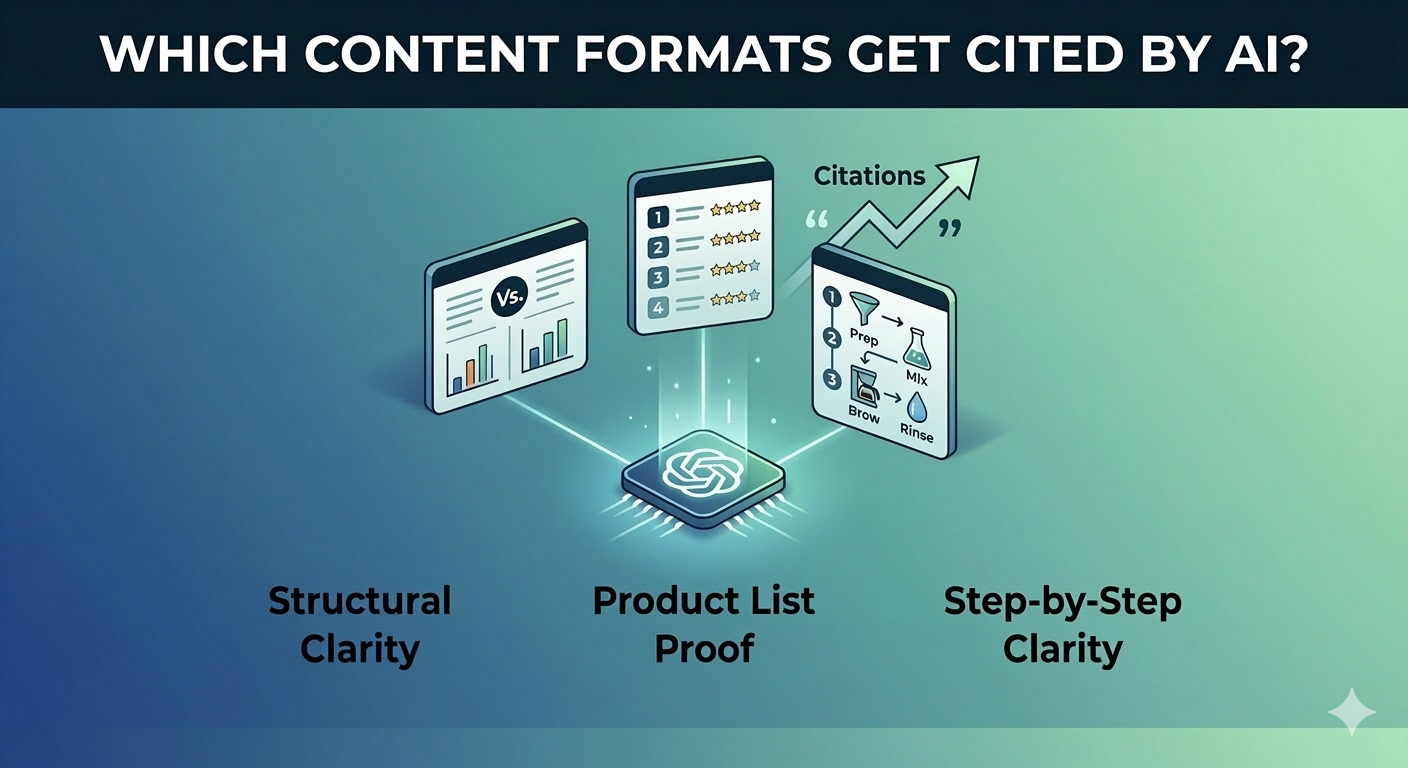
Across all 50 prompts, three patterns showed up over and over:
Structured posts and listicles. Step-by-step guides, numbered lists, bullet points — anything that makes the content easy to extract. AI tools aren’t reading your prose for nuance; they’re scanning for clean, usable chunks.
High-authority domains. Wikipedia entries, well-known SEO blogs (Moz, Ahrefs, Backlinko), established brands. Domain authority still matters a lot.
Community discussions. Reddit threads, Quora answers, LinkedIn posts. AI tools treat community validation as a trust signal. If real people are debating it, it’s worth citing.
| Prompt | Top AI Sources | Content Type | Pattern |
|---|---|---|---|
| Best SEO tools for SMBs | GSC, SEMrush, Ahrefs | Blog/Listicle | Structured + authoritative |
| Best AI marketing tools | ChatGPT, Jasper, Surfer SEO | Blog/Listicle | Wikipedia & high-DR blogs |
| Notion vs ClickUp | Notion, ClickUp | Reddit/Blog | Community + structured comparisons |
| How to improve SEO | Moz, Ahrefs, Backlinko | Step-by-step | Bullet points & headings |
Recommendation Prompts: Brand Recognition Wins
When someone asks “what’s the best tool for X,” AI goes straight to names it knows. GSC, SEMrush, ChatGPT, Jasper — these show up constantly because they have the authority signals to back them up.
Newer or lesser-known tools do get cited, but only when community discussions or high-DR blogs mention them first. If you’re trying to get a newer product cited, that’s your path in: earn mentions on Reddit, get reviewed on authoritative blogs, build up the validation signals that AI treats as proof of legitimacy.
| Prompt | Tools Cited | Pattern |
|---|---|---|
| Best SEO tools for SMBs | GSC, GA4, SEMrush, Ahrefs | AI sticks to authoritative sources |
| Best AI marketing tools | ChatGPT, Jasper, Surfer SEO, Predis.ai | High-DR blogs & Wikipedia dominate |
| Best productivity apps | Notion, Todoist, ClickUp, Trello | Community discussions push results |
How-To Prompts: Structure Is Everything
This one is simple. How-to content lives or dies by its format.
Numbered steps, short paragraphs, clear headings, practical examples — that’s what AI pulls from. It’s not looking for your most insightful paragraph buried in the middle of a 2,000-word post. It wants a clean, extractable block it can drop straight into an answer.
If your how-to content is written as long flowing prose with no visual hierarchy, it’s probably getting skipped.
Comparison Prompts: Data + Community
Side-by-side comparisons (Ahrefs vs SEMrush, Notion vs ClickUp, Mailchimp vs ConvertKit) are a high-value content format because AI handles them differently than other prompts.
It combines structured analysis — pros/cons, feature tables, use case breakdowns with community signals. A well-formatted comparison post that also gets discussed on Reddit has a real shot at showing up in AI answers.
| Prompt | AI Sources | Format | Pattern |
|---|---|---|---|
| Ahrefs vs SEMrush | Blogs, Reddit, Forbes | Bullet points + table | Structured + community validation |
| Notion vs ClickUp | Blogs, Reddit | Step-by-step list | Community discussions influence results |
| Mailchimp vs ConvertKit | Blogs | Bullet points | Side-by-side format improves extractability |
Local & Authority Prompts: Trust Signals Over Everything
Prompts like “best SEO agency in London” or “top SEO consultants” behave a bit differently. Here, AI leans heavily on trusted listicles and structured summaries from high-authority blogs and forums.
Unknown providers almost never show up unless they’re mentioned in a trusted source. The entry point is the same as recommendation prompts — get cited somewhere authoritative, then the AI will start citing you.
What You Should Actually Do
The research points to a pretty clear playbook. Here’s what moves the needle:
Format for extraction. Every piece of content should have clear headings, bullet points or numbered steps, and short paragraphs. Write like someone who wants to make their content easy to quote. (Learn: How to improve brand visibility in AI)
Cite and reference credible sources. High-DR blogs, Wikipedia, Moz, Ahrefs, Backlinko — linking out to authoritative sources signals that your content belongs in that league.
Build community validation. Publish, then get the conversation going on Reddit, Quora, LinkedIn. AI treats community discussion as social proof. Don’t just create content — create conversation.
Build topical clusters. One strong post isn’t enough. AI rewards sites that cover a topic thoroughly. Build connected content across the topic and let the cluster build authority together. (See AI Visibility Case Study for examples.)
Keep your stack small and trusted. Across the 50 prompts, the tools that got cited most weren’t the newest or most feature-rich — they were the most established. For most businesses, a focused stack works better than a sprawling one:
| Function | Tool |
|---|---|
| SEO | GSC, GA4, Ubersuggest |
| Content | ChatGPT |
| Social Media | Predis.ai |
| Automation | HubSpot |
The Bottom Line
After 50 prompts, the pattern is consistent: structured content wins, authority signals matter, and community validation is what pushes lesser-known sources into the mix.
The tools that get cited aren’t always the best — they’re the ones that made themselves easy to trust and easy to extract. Format for AI, build authority, and get people talking about your content. That’s the playbook. Read about AI visibility hard truths.
(Ready to put this into practice? Audit your AI Visibility)
Leave a Reply