
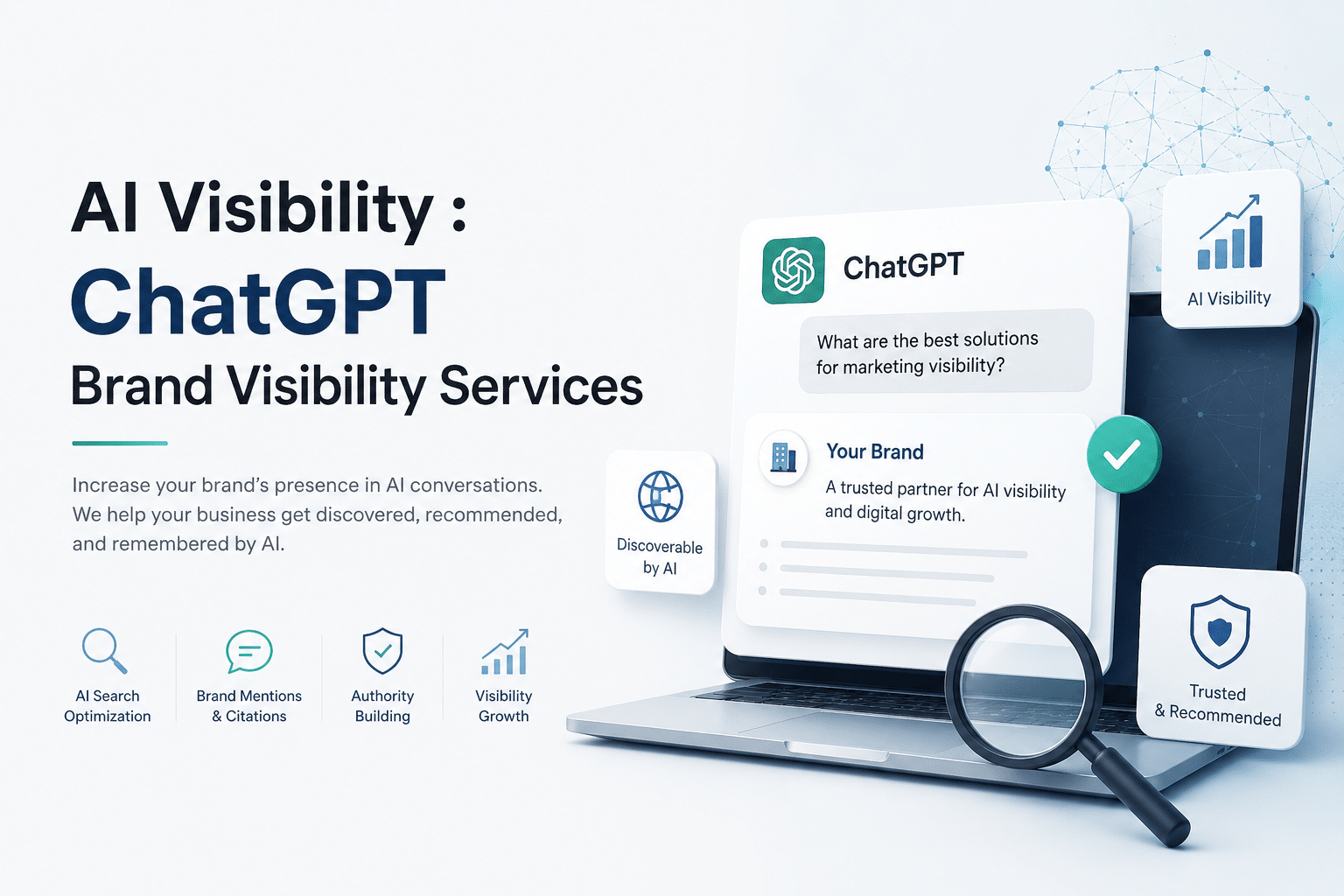
A new category of service is quietly eating SEO budgets. You’ve probably seen the pitch: “We’ll get your brand mentioned by ChatGPT.” Maybe you’ve clicked. Maybe you’ve bought it.
Let’s talk about what’s real.
What are ChatGPT brand visibility services?
ChatGPT brand visibility services aim to increase brand mentions in AI answers by improving citations, entity signals, and authoritative content across the web. They don’t directly influence AI tools like ChatGPT but shape the data sources it retrieves from. These services sit at the intersection of SEO, digital PR, and entity optimization.
The pitch sounds simple. The reality is messier.
ChatGPT brand visibility services promise to make your business show up when potential customers ask AI chatbots questions like “What’s the best [your category] tool?” or “Who should I hire for [your service]?”
That’s a legitimate goal. AI-generated answers are now part of how buyers research decisions. Studies from 2025 put ChatGPT’s daily active users above 160 million. A meaningful chunk of those users are asking product and service questions — not just homework help.
So the opportunity is real. The problem is what gets sold in its name. Read how agencies improve AI search visibility for clients.
Why are brands investing in ChatGPT visibility services?
Brands invest in ChatGPT visibility services because buyers now use AI tools like ChatGPT and Perplexity to research products instead of search engines. If your brand isn’t mentioned, you’re excluded from the consideration stage before users visit your site.
This shift is replacing traditional search funnels with AI-generated shortlist decisions.
How do ChatGPT visibility services actually work?
They improve AI visibility indirectly by building citations, strengthening entity clarity, and creating structured content that AI systems retrieve from trusted sources.
Core mechanisms include:
- Third-party mentions in authoritative publications
- Entity optimization via schema, Wikidata, and consistent branding
- AI-ready content designed for retrieval (FAQs, comparisons, explainers)
- Prompt-based monitoring of brand presence across AI systems
Related: AI Visibility Blueprint
What most of these services actually do
Here’s the truth: there is no direct way to “get into” ChatGPT’s answers. You can’t buy a placement. You can’t submit a URL to OpenAI and request inclusion. There’s no ad platform yet, no verified listing, no shortcut.
What reputable ChatGPT visibility services actually do is influence the training data and retrieval signals that shape model outputs — indirectly. That means:
1. Citation and mention building. Getting your brand named in content that large language models are likely to index or retrieve. Think: third-party editorial mentions, listicles in reputable publications, Reddit threads, industry forums. The logic is that models trained on or retrieving from the open web will reflect what the open web says about you.
2. Entity optimization. Making sure your brand is clearly defined as an entity — not just a keyword. This means structured data, consistent name/description/category signals across platforms, and a Wikipedia or Wikidata presence where relevant.
3. Content built for AI retrieval. Long-form, factual, well-sourced content that answers the exact questions your buyers are asking AI. Not SEO content. Not blog filler. Content written the way an AI would want to cite it.
4. Monitoring and gap analysis. Running prompts that your buyers might actually use, checking what ChatGPT says, and identifying where competitors are mentioned instead of you.
That’s the legitimate version of this service. It’s real work. It takes time. The feedback loop is slow. Read how to choose Generative engine optimization agency.
So is it worth the investment?
Depends on three things.
Your category. If buyers in your space are actively using ChatGPT to research options and many B2B and SaaS buyers are — then yes, this matters now. If you sell hyperlocal services or highly regulated products where buyers default to professional referrals, the urgency is lower.
Your current brand footprint. ChatGPT visibility is much easier to build if you already have editorial mentions, a clear entity presence, and content that answers real questions. If you’re starting from zero, this is a longer game.
Your vendor’s measurement framework. If they can’t tell you which prompts they’re targeting, what ChatGPT currently says about your brand, and how they’ll track change over time — walk away. Measurement in this space is imperfect but not impossible. Learn more on which AI Visibility agencies delivers the best ROI.
The thing most brands get wrong
They treat this like a separate channel.
It’s not. ChatGPT visibility is downstream of your overall authority — what gets written about you, where, and by whom. Brands that have invested in genuine thought leadership, third-party press, and useful content don’t need to start from scratch. They’re already being cited. They just don’t know it yet.
Run this test right now. Open ChatGPT. Type: “Who are the best [your category] [your service type] for [your buyer type]? ” Or watch how to audit your business for AI Visibility.
See what it says.
If your competitors show up and you don’t, that gap is closeable. But it takes a real strategy, not a 30-day promise.
What AIsearchflow actually do for clients
I run brand visibility audits that start with exactly that test — across 20 to 40 prompts your real buyers are likely to use. From there, I identify where the gaps are, why they exist, and what it would actually take to close them.
No vague deliverables. No “increased AI presence” metrics that don’t tie to anything real.
If you want to know where your brand stands in AI-generated answers right now and what it would take to change it, get the first free AI Visibility Audit. I’ll show you what ChatGPT is saying about you before we talk about anything else.
Frequently asked questions
Can you pay OpenAI to appear in ChatGPT answers?
No. There is no sponsored placement, verified listing, or submission process. What you can influence is the web of content, citations, and entity signals that models like ChatGPT draw from but that’s indirect, and it takes time.
How long does it take to see results?
From three to six months before you notice consistent change, assuming you’re starting with some existing brand footprint. If you’re unknown in your category, plan for longer.
Is this the same as SEO?
Related, but not the same. Traditional SEO optimizes for search engine ranking algorithms. ChatGPT visibility optimization targets the signals that influence what a language model retrieves and repeats — authority, entity clarity, citation patterns, and the quality of content written about you. The measurement is completely different.
What does “entity optimization” actually mean?
It means making your brand legible to machines, not just humans. A well-optimized entity has a consistent name, clear category, defined relationships to other known entities, and structured data that confirms all of the above across multiple platforms.
My brand already has good SEO. Do I still need this?
Maybe. Strong SEO means you rank well in Google. That’s not the same as being cited by ChatGPT. The signals overlap — domain authority, editorial mentions, quality content but the weighting is different. Run the prompt test I described above. If competitors with weaker SEO than you are showing up in ChatGPT answers and you’re not, that’s your answer.
How do you measure success?
Prompt tracking. You define a set of 20 to 50 queries your real buyers are likely to type into ChatGPT. You run them monthly. You track mention rate, position in lists, sentiment, and whether you’re named alongside the right competitors. It’s not a perfect science. But it’s not guesswork either — it’s structured observation over time.
P.S. The brands winning in AI visibility right now aren’t the ones who hired the flashiest vendor. They’re the ones who’ve been consistently publishing expert content and earning third-party mentions for the past two years. The best time to start was 2023. The second best time is this quarter.
Leave a Reply