
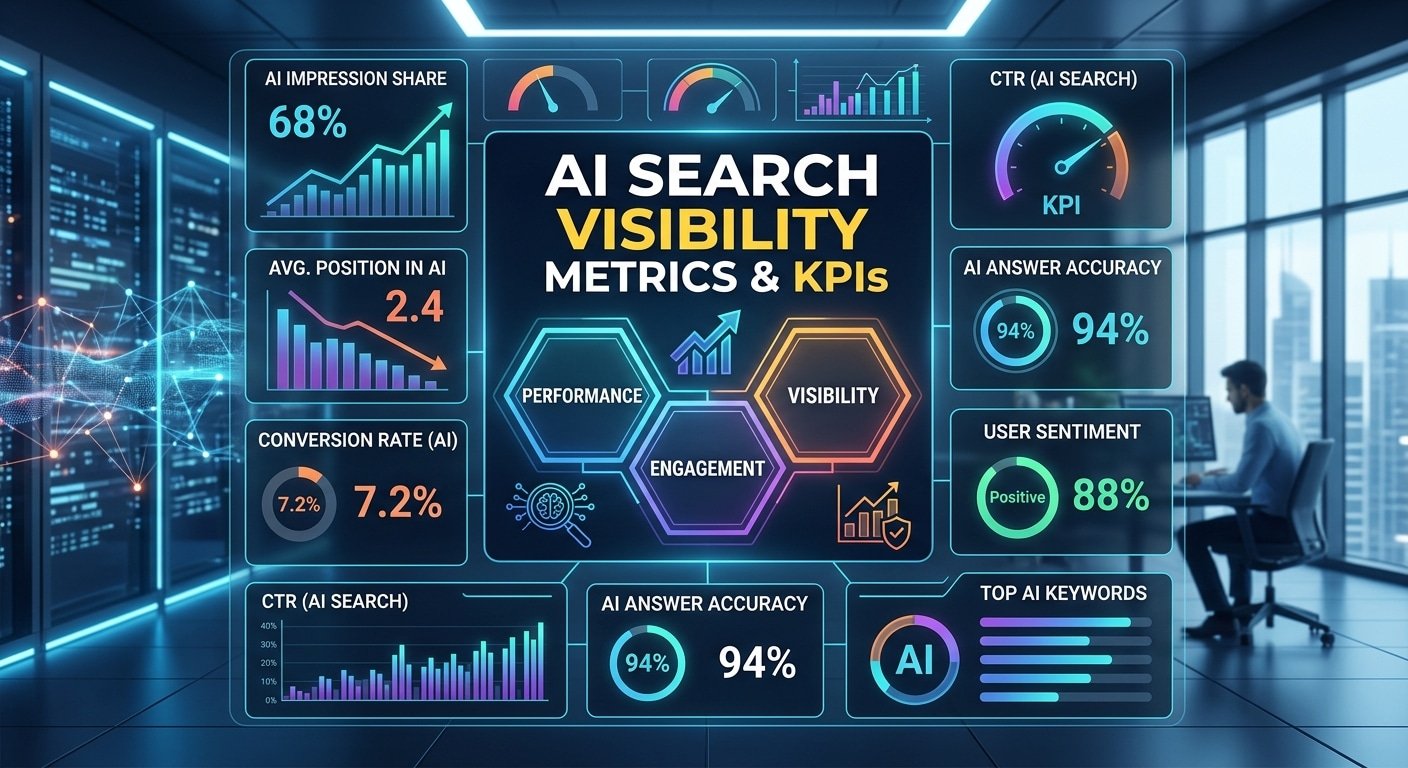
Traditional SEO metrics still matter. Rankings, impressions, clicks, traffic, and conversions tell you how your website performs in search and what happens when people visit it. But they do not fully describe what happens when someone asks ChatGPT, Google AI Mode, Gemini, or Perplexity for an answer and receives information without visiting your website first. A customer may discover your company, compare it with competitors, see it recommended, or read a summary of your services inside an AI-generated answer. That interaction can influence the customer before a measurable website visit occurs. That is why AI search visibility metrics add a second measurement layer alongside traditional SEO.
This guide explains which AI search visibility KPIs matter, how to calculate them, how to compare your business with competitors, where the data can be unreliable, and what to investigate when a metric is weak. For a broader introduction to the subject, see AI search visibility full guide.
What are AI search visibility metrics?
AI search visibility metrics measure how frequently, prominently, accurately, and competitively a business appears in AI-generated answers. They can also measure whether the business or its website is cited and whether AI-related discovery leads to measurable website visits or enquiries. Instead of asking only, “Where does my page rank?”, AI visibility measurement asks several different questions:
- Does the business appear at all?
- How often does it appear?
- Which prompts cause it to appear?
- Does the AI recommend it or only mention it?
- Is the business cited as a source?
- Which competitors appear more often?
- Is the information about the business correct?
- Does AI-related visibility contribute to traffic, leads, or conversions?
Different metrics answer different parts of that problem.
| Measurement | Simple definition |
|---|---|
| Visibility | Whether and how often your business appears |
| Citations | Whether your website or another source is referenced |
| Competitive presence | How often you appear compared with competitors |
| Prominence | How strongly or early your business appears in an answer |
| Coverage | Which customer questions and topics you appear for |
| Brand quality | Whether AI describes the business correctly and positively |
| Business impact | Whether AI visibility contributes to traffic, enquiries, or conversions |
These measurements should not replace SEO reporting. They add information that rankings and website analytics alone cannot always show.
Which AI search visibility metrics should you track?
Most businesses should start with mention rate, share of voice, citation rate, prompt coverage, answer prominence, accuracy, and measurable business outcomes. You do not need twenty different AI search metrics from day one.
A useful starting framework is below.
| Metric | What it measures | Why it matters | Priority |
|---|---|---|---|
| Mention rate / visibility rate | How often your business appears in tested AI answers | Shows basic discoverability | High |
| AI share of voice | Your mentions compared with tracked competitors | Shows competitive visibility | High |
| Citation rate | How often your website or content is cited | Shows whether your content is being used as a source | High |
| Citation share | Your citations compared with competing sources | Highlights competitive source strength | Medium to High |
| Answer position / prominence | How visibly and strongly the brand appears | Separates strong recommendations from minor mentions | High |
| Prompt coverage | How many important customer questions you appear for | Finds gaps hidden by an overall visibility score | High |
| Brand accuracy and sentiment | Whether AI describes the business correctly and appropriately | Visibility is less useful when information is wrong | High |
| AI referral traffic | Visits arriving from AI platforms | Connects visibility with website activity | Medium |
| AI-influenced leads or conversions | Enquiries or sales where AI may have contributed | Connects measurement with business outcomes | High when measurable |
The exact priorities depend on the business.
A local roofing company may care more about appearing in “best roofer near me” and service-specific recommendations than being mentioned in broad educational questions. A national software company may need hundreds of prompts across product categories, comparisons, problems, and competitors. The important point is to measure the searches that matter to potential customers.
What is AI visibility or mention rate?

AI mention rate is the percentage of tested AI responses in which your business appears. It is one of the simplest AI visibility metrics and a useful starting point for measuring whether AI systems include your brand in relevant answers.
A basic formula is:
Mention Rate = Responses where your business appears ÷ Total relevant responses tested × 100
For example:
You test 27 relevant AI responses.
Your business appears in 9.
Mention Rate = 9 ÷ 27 × 100 = 33.3%
A 33.3% mention rate does not mean that 33.3% of all ChatGPT users see your company. It only describes visibility within the prompt sample and testing method you used.
That distinction matters.
Why is one AI prompt not enough?
One prompt is not enough because AI-generated answers can change and small wording changes can produce different results.
Imagine testing only:
Who is the best roofing company in Austin?
Your company does not appear.
That does not prove your business is invisible across AI search.
Other customers might ask:
- Who repairs leaking roofs in Austin?
- Best residential roofing contractors in Austin.
- Who installs metal roofing near Austin?
- Compare roofing companies in Austin.
- Reliable roof replacement company near me.
- Which Austin roofer has strong customer reviews?
A useful visibility test therefore needs a group of realistic customer questions.
For ideas on building a broader query set, see these AI search prompts.
How should mention rate be segmented?
Mention rate becomes more useful when you break it into meaningful groups instead of reporting only one percentage.
Useful segments include:
- AI platform
- Service
- Product category
- Customer intent
- Location
- Topic
- Funnel stage
- Competitor
- Branded versus non-branded prompts
For example, a contractor could have 60% visibility for roof repair questions but only 8% visibility for metal roofing questions.
An overall score of 34% would hide that gap.
What is AI share of voice?

AI share of voice measures how much of the tracked brand presence belongs to your business compared with competitors. Mention rate asks whether you appear. Share of voice asks how much of the competitive conversation you occupy when brands are mentioned.
A simple formula is:
AI Share of Voice = Your brand mentions ÷ Total mentions of all tracked brands × 100
Imagine three roofing companies were mentioned 100 times across the same test set.
| Business | AI mentions | Share of voice |
|---|---|---|
| Your Roofing Co. | 25 | 25% |
| Competitor A | 45 | 45% |
| Competitor B | 30 | 30% |
| Total | 100 | 100% |
Your business has a 25% AI share of voice.
This differs from mention rate. You could appear in 40% of tested responses but still have a relatively small share of voice if several competitors appear more frequently in the same answers.
What is a good AI share of voice?
There is no universal percentage that represents a good AI share of voice for every business. The useful comparison is against relevant competitors, important prompt groups, and your own results over time. A local contractor with five serious competitors should not evaluate its performance using the same expectations as a global software category containing hundreds of brands.
The goal is also not to appear in every possible AI conversation but to appear consistently in the conversations that matter to your customers.
What is citation rate in AI search?

AI citation rate measures how frequently your website or content is referenced as a source in the AI answers you test. A citation is different from a brand mention.
For example:
ABC Roofing is one company to consider.
That is a mention.
If the answer also references or links to abcroofing.com/services/metal-roofing, that website has received a citation.
A practical citation-rate formula is:
Citation Rate = Responses containing a citation to your site ÷ Total relevant responses tested × 100
If you test 50 responses and your website is cited in 8:
Citation Rate = 8 ÷ 50 × 100 = 16%
You should document exactly how you calculate the metric because different tools may define citation rate differently.
What can citation rate tell you?
Citation rate can show whether your owned content is being used or surfaced as supporting material in AI answers.
A low citation rate may point to areas worth investigating, such as:
- Weak coverage of important customer questions
- Pages that do not clearly answer the topic
- Better competing sources
- Poor crawlability or indexing
- Weak source authority
- Important information existing only on third-party websites
However, citation rate does not tell you everything.
A business can be mentioned without its website being cited. A website can also be cited in an informational answer without the business being recommended.
Most importantly, more citations do not automatically mean more customers. If citations are a weak point, this guide explains how to structure your content to earn AI citations.
What is citation share?

Citation share measures the proportion of tracked citations that belong to your site compared with competing sites or brands.
One practical formula is:
Citation Share = Your citations ÷ Total citations across the tracked competitive set × 100
Suppose a group of AI answers contains:
- 18 citations to your website
- 32 citations to Competitor A
- 20 citations to Competitor B
- 30 citations to other tracked sources
There are 100 tracked citations in total.
Your citation share is:
18 ÷ 100 × 100 = 18%
Citation share is useful because a raw citation count has little context.
Eighteen citations could be strong if competitors receive five each. It could be weak if the leading competitor receives 200.
What can competitor citation share reveal?
Competitor citation share can help identify which businesses, pages, and third-party sources repeatedly support AI answers in your market.
If competitors consistently receive more citations, investigate:
- Which pages are being cited
- Which topics those pages cover
- Which customer questions they answer
- Whether third-party reviews or directories are being cited
- Whether the content is more specific or current
- Whether your equivalent information is missing or difficult to find
Treat these findings as investigation clues, not proof of a single ranking factor.
How do you measure where your business appears in an AI answer?
Measure AI answer position by recording where the business appears, how strongly it is described, and whether it is actually recommended. A first recommendation is usually more meaningful than a company name buried near the end of a long response.
You can create a simple classification system.
| Appearance type | Example interpretation |
|---|---|
| First recommendation | Business is the first option suggested |
| Strong recommendation | Business receives clear positive recommendation language |
| Neutral mention | Business is listed without a strong recommendation |
| Peripheral mention | Business appears only as a minor example or side note |
| No appearance | Business is absent |
For list-style responses, you can also record numerical position.
For example:
- Competitor A
- Your Business
- Competitor B
- Competitor C
Your answer position is 2.
Across many responses, you can calculate an average position.
Average Position = Sum of recorded positions ÷ Number of responses where the business appeared
Keep mention rate next to average position.
A company with an average position of 1.5 but only two appearances may have less useful visibility than a competitor averaging position 2.4 across 60 relevant answers.
Is AI answer position the same as a Google ranking?
No. AI answer position should not be treated like a traditional Google ranking position. AI-generated responses can change in wording, ordering, format, and the number of companies included. Some answers may contain a numbered list. Others may discuss several options in paragraphs. Position is therefore a useful directional metric, not a fixed search ranking.
What is prompt coverage?

Prompt coverage measures how broadly your business appears across the important questions customers might ask. It helps reveal gaps that can disappear inside one overall visibility percentage.
One useful definition is:
Prompt Coverage = Important tracked prompts with a qualifying appearance ÷ Total important tracked prompts × 100
For example, you track 40 distinct customer questions.
Your business appears at least once for 22 of them during the measurement period.
Prompt Coverage = 22 ÷ 40 × 100 = 55%
Prompt coverage and mention rate can be calculated differently.
If every prompt is tested five times, you have 200 total responses. Mention rate can measure appearances across those 200 responses, while prompt coverage measures whether you have visibility across the 40 distinct questions.
Which prompt types should you track?
Track prompts that represent different customer intentions, not dozens of tiny variations of the same question.
| Prompt type | Example | What to measure |
|---|---|---|
| Informational | How long does a metal roof last? | Citations, topic coverage |
| Service | Who installs metal roofs in Denver? | Mentions, position |
| Comparison | Metal roof vs asphalt shingles for Colorado homes | Citations, coverage |
| Recommendation | Best metal roofing companies in Denver | Mentions, recommendations, share of voice |
| Local | Roofer near me for hail damage | Local presence, accuracy |
| Problem-based | Who can fix a leaking roof after a storm? | Service relevance |
| Competitor | ABC Roofing alternatives | Competitive visibility |
Broad prompt coverage matters because customers rarely describe the same need in exactly the same words.
How do you measure brand accuracy and sentiment in AI search?
Measure brand accuracy by checking whether factual statements about the business are correct, and measure sentiment separately by evaluating how positively or negatively the business is described. Visibility is not automatically good.
An AI system could mention your company while providing:
- The wrong services
- The wrong location
- Old opening hours
- Outdated pricing
- An incorrect service area
- Confusion with another company
- Incorrect product information
- Outdated business positioning
- A negative or misleading description
Accuracy and sentiment are related but different.
Accuracy asks: Is the information correct?
Sentiment asks: How is the business being portrayed?
For example:
An AI assistant says:
Northside Roofing operates throughout Dallas and specializes in commercial roofing.
Suppose Northside Roofing actually works only in Fort Worth and focuses mainly on residential projects.
The answer could sound positive while still being factually wrong.
That is an accuracy problem, not necessarily a sentiment problem.
How can brand accuracy be scored?
A simple audit can classify important claims as:
- Correct
- Partially correct
- Incorrect
- Outdated
- Unable to verify
If 91 of 100 audited factual claims are correct, you could report 91% accuracy.
Keep the scoring rules consistent between reporting periods.
How do you measure AI search traffic and leads?
Measure AI-related business impact using direct referral traffic where available, analytics attribution, lead-source questions, and supporting signals such as branded search. No single method captures every AI-influenced customer journey.
What is AI referral traffic?
AI referral traffic is website traffic that arrives through a measurable link from an AI platform. Google Analytics can identify where sessions originate through traffic-source dimensions such as Session source and Session source/medium. Its Traffic acquisition report is therefore useful for identifying measurable AI referrals when the referrer is available.
For ChatGPT specifically, OpenAI documents that web-search answers can provide links and citations to sources. See the official ChatGPT Search documentation.
Do not assume that every AI-assisted discovery will appear with a clean referral source.
A customer could:
- Discover your company in an AI answer.
- Close the AI assistant.
- Search your business name on Google.
- Visit the website.
- Submit a form.
Analytics might attribute that website session to Google rather than the original AI interaction.
Which business-impact signals can you track?
| Signal | What it tells you | Main limitation |
|---|---|---|
| AI referral sessions | Direct measurable visits from AI platforms | Misses journeys without a click |
| AI-referred users | Number of users arriving through identifiable AI sources | Referrer data may be incomplete |
| AI-referred conversions | Leads or sales following measurable AI visits | Captures only attributable journeys |
| Attribution paths | Whether measurable channels contributed before conversion | Untracked AI exposure cannot be reconstructed |
| Self-reported discovery | Customer says an AI tool helped them find the company | Depends on customer memory |
| Branded search | Changes in searches for the brand | Cannot prove what caused the change |
| Direct traffic | Possible later visit after discovery elsewhere | Source is highly ambiguous |
Google Analytics also provides attribution reports that assign conversion credit across measurable touchpoints.
Does branded search growth prove AI visibility is working?
No. An increase in branded searches can support an AI-influence hypothesis, but it does not prove that AI caused the increase. Branded search can change because of advertising, social media, word of mouth, news coverage, offline marketing, seasonality, or other factors. Treat it as a supporting signal alongside direct referrals, visibility trends, lead-source data, and other evidence.
How should you measure AI visibility across different prompts?

Build a defined prompt set, group the prompts by customer intent, test them repeatedly, and measure trends instead of relying on a single answer. This is one of the most important parts of reliable AI search visibility measurement. A useful process looks like this:
1. Build prompts from real customer needs
Start with questions connected to:
- Services
- Problems
- Products
- Locations
- Comparisons
- Alternatives
- Buying decisions
- Recommendations
- Common objections
Do not build the entire test around your company name.
Non-branded questions often reveal whether the business is discoverable when the customer does not already know it exists.
2. Divide prompts into groups
For example, a roofing company could use:
Roof repair
- Best roof repair company in Denver
- Who repairs leaking roofs in Denver?
- Emergency roof repair near Denver
Roof replacement
- Best roof replacement contractor in Denver
- How do I choose a Denver roofing company?
- Recommended company for replacing an old roof
Metal roofing
- Best metal roof installer in Denver
- Who installs standing-seam roofs near Denver?
- Metal roofing contractors for residential homes
The grouped results are much easier to interpret than one combined number.
3. Run more than one test
AI answers can vary. Repeat important prompts over time instead of assuming one response represents a permanent result. This is especially important for recommendation questions where the order and number of businesses can change.
4. Use the same core prompt set for competitors
If your company is measured using 100 prompts but Competitor A is measured using only 20, the comparison is weak. Use the same testing conditions where possible.
5. Keep historical results
Track:
- Date
- Platform
- Prompt
- Business mentioned
- Competitors mentioned
- Position
- Citations
- Cited URL
- Sentiment
- Accuracy issues
That turns individual AI answers into a dataset.
6. Watch trends
A change from 21% to 23% mention rate after one small sample may mean very little. A sustained improvement across several prompt groups and repeated measurement periods is more useful.
This is also why an audit of your website for AI visibility should establish a baseline before changes are made.
Should you measure AI visibility against competitors?
Yes, when customers are likely to compare your business with alternatives. Competitive measurement adds context that an absolute visibility score cannot provide.
A 25% mention rate may initially look weak.
But if every direct competitor has less than 10%, your position looks very different.
The opposite is also true.
A 45% mention rate can look strong until you discover that your three main competitors appear in 70% to 80% of the same questions.
Illustrative competitor comparison
The following numbers are an example only. They are not real company data.
| Metric | Your business | Competitor A | Competitor B |
|---|---|---|---|
| Mention rate | 24% | 41% | 32% |
| Citation rate | 12% | 27% | 18% |
| Share of voice | 14% | 31% | 22% |
| Average position | 3.8 | 2.1 | 3.0 |
| Accuracy | 91% | 88% | 84% |
This example creates several useful questions. Competitor A appears much more frequently and receives more citations. Which pages and third-party sources support those appearances? Your business has the best accuracy score. Is that because your company information is more consistent, or because it appears in fewer answers?
Competitor B has better visibility but lower accuracy. Which incorrect claims are being repeated? The purpose of competitor analysis is not simply to copy competitors. It is to find what they are consistently winning and investigate why.
If another company keeps appearing instead of yours, see why AI recommends competitors for a deeper diagnostic approach.
Are AI visibility scores reliable?
AI visibility scores are useful directional measurements, but they are not universal or perfectly precise measurements of every AI interaction. Their reliability depends heavily on the prompts, platforms, sampling method, definitions, and testing frequency used. There is no single industry-wide AI visibility score that every platform calculates in exactly the same way.
Differences can come from:
- Different prompt libraries
- Different AI platforms
- Different models
- Different locations
- Different test frequencies
- Different definitions of mentions
- Different citation rules
- Different competitor sets
- Different weighting systems
- Changing AI responses
This is why a score such as “AI Visibility: 62” should never be interpreted without understanding how the number was calculated.
What is more reliable than one overall score?
Trends across a consistent methodology are generally more useful than obsessing over one score.
Focus on:
- The same important prompt groups
- Repeated testing
- Platform-level results
- Competitor comparisons
- Changes over time
- Clear metric definitions
Also avoid treating third-party tracking data as direct access to an AI platform’s internal ranking systems. Google explicitly warns site owners that third-party tools do not have access to Google’s internal ranking or AI systems.
What traditional SEO metrics should you still track?
Continue tracking traditional SEO metrics alongside AI visibility because AI search does not replace traditional search. The two measurement layers answer different questions. Google’s own guidance says foundational SEO practices remain relevant to its generative AI features.
| Traditional SEO | AI search visibility |
|---|---|
| Rankings | Mentions and position |
| Impressions | Prompt visibility |
| CTR | AI referral traffic |
| Organic traffic | AI referral and influenced traffic |
| Backlinks | Sources and citations |
| Conversions | AI-influenced leads and conversions |
Google’s official Search Console Performance report documentation covers clicks, impressions, CTR, and average search position. These remain important website performance metrics.
In 2026, Google also introduced dedicated reporting for generative AI visibility in Search Console. Google states that its generative AI performance reports provide dedicated visibility information for features such as AI Overviews and AI Mode, and that these signals also feed into broader Search performance reporting.
See Google’s official Generative AI Search Console guidance for current details.
That makes the measurement model clearer:
Traditional SEO tells you how search visibility and website visits are performing. AI visibility measurement adds information about how the brand and its sources appear inside generated answers.
You need both.
Which AI search metrics matter most for local businesses?
Local businesses should prioritize AI metrics connected directly to service, location, recommendation, and customer-intent searches. A local company does not need to measure every informational prompt on the internet.
The most useful priorities are usually:
- Mention rate for local searches
- Recommendation presence
- Share of voice against local competitors
- Citation and source presence
- Accuracy of business information
- Service and location prompt coverage
- AI-influenced enquiries where measurable
What would this look like for a local roofing company?
Suppose a roofer operates in Denver and nearby suburbs.
A useful prompt library could include:
- Best roofing company in Denver
- Roof repair contractor in Denver
- Who repairs hail-damaged roofs near Denver?
- Best metal roofing installer in Denver
- Roof replacement company near Lakewood
- Reliable roofing contractors in Aurora
- Who should I call for an emergency roof leak?
- Which Denver roofing company has good reviews?
The company could then track:
| Metric | Example question |
|---|---|
| Local mention rate | Do we appear in Denver recommendation searches? |
| Service coverage | Do we appear for repair, replacement, metal roofing, and hail damage? |
| Geographic coverage | Do we appear in Denver but disappear in Lakewood or Aurora? |
| Local share of voice | Which nearby roofing companies appear more often? |
| Accuracy | Does AI show the correct service area and services? |
| Citations | Which websites support local recommendations? |
| Enquiries | Are customers reporting that ChatGPT or another AI tool helped them find us? |
For a local business, strong visibility for one high-intent service can be more commercially useful than broad visibility for dozens of unrelated educational questions.
How can you improve the AI search metrics that are weak?
Use weak metrics as diagnostic signals. Do not treat them as isolated numbers that need to be increased at any cost. Each metric can point toward an area worth investigating, but one metric rarely proves one specific cause.
| Problem | What it may indicate | What to investigate |
|---|---|---|
| Low mention rate | Weak relevance or unclear business information | Services, pages, business information |
| Low citation rate | Weak or unclear source content | Website structure, useful content, crawlability |
| Low share of voice | Competitors have stronger signals | Competitor sources, content gaps, third-party presence |
| Poor position | Business appears but is not strongly recommended | Relevance, reviews, trust, content |
| Low prompt coverage | Narrow topical presence | Missing services, topics, questions, locations |
| Poor accuracy | Conflicting or outdated information | Website, profiles, directories, third-party sources |
| Strong visibility but weak leads | Visibility may not match commercial intent | Prompt selection, offers, landing pages, attribution |
What should you do about a low mention rate?
Investigate whether the business clearly explains:
- What it does
- Where it operates
- Who it serves
- Which services it offers
- Which problems it solves
Then compare those signals with businesses that appear more consistently.
What should you do about a low citation rate?
Investigate whether useful, specific information exists on accessible pages. A service page containing only sales language may provide less useful supporting information than a page that clearly explains the service, process, costs, limitations, common questions, and who the service is suitable for. Also check crawlability, indexing, internal linking, and competing sources.
What should you do about weak competitor share of voice?
Find the prompts where competitors repeatedly win.
Then inspect:
- Their relevant pages
- Reviews
- Business listings
- Third-party mentions
- Source citations
- Service coverage
- Location information
- Supporting content
You are looking for gaps, not a page to copy. For broader improvement ideas, see how to increase visibility in ChatGPT. None of these changes guarantees a recommendation. AI platforms use their own systems, sources, models, and retrieval methods.
What tools can track AI search visibility?
AI visibility can be tracked manually, with analytics and search data, or with dedicated AI visibility tools that automate prompt testing and competitive monitoring. Each approach measures a different part of the problem.
Useful tool categories include:
Manual prompt testing: Useful for small businesses establishing an initial baseline.
AI visibility tracking platforms: Useful for repeatedly tracking large prompt sets, mentions, citations, competitors, positions, and trends.
Google Search Console: Useful for Google Search performance. In 2026, Google also provides dedicated reporting for visibility in generative AI features.
Google Analytics 4: Useful for identifying measurable referral traffic and conversion activity.
Spreadsheets or databases: Useful for maintaining custom prompt sets, historical responses, citation URLs, accuracy issues, and competitor data.
A dedicated tracker can save a large amount of manual work, but methodology still matters.
Two tools can report different visibility scores because they may test different prompts, models, countries, frequencies, and competitors.
For a detailed comparison, see the guide to AI visibility tools.
What should an AI search visibility KPI report include?
A useful AI visibility report should show visibility, citations, competitive position, brand quality, and business impact without burying the reader in dozens of metrics.
A practical report can be divided into five sections.
Visibility
- Mention rate
- Prompt coverage
- Share of voice
Sources
- Citation rate
- Citation share
- Most frequently cited pages
- Most frequently cited third-party domains
Position
- Average position
- First-position frequency
- Recommendation frequency
Brand
- Accuracy
- Sentiment
- Incorrect or outdated information
Business impact
- AI referral traffic
- AI-reported leads
- AI-attributed conversions
- AI-assisted conversions where measurable
What could an AI visibility dashboard look like?
The example below is illustrative.
| KPI | Current period | Previous period | Main observation |
|---|---|---|---|
| Mention rate | 31% | 24% | Visibility increased |
| Prompt coverage | 58% | 49% | More topic groups now contain appearances |
| AI share of voice | 22% | 18% | Competitive presence improved |
| Citation rate | 14% | 15% | Mostly unchanged |
| Average position | 2.7 | 3.1 | Average placement improved |
| Accuracy | 94% | 89% | Fewer incorrect claims |
| AI referral sessions | 76 | 54 | More directly measurable visits |
| AI-reported leads | 6 | 3 | Small sample, continue tracking |
A dashboard should make the next investigation obvious. If it only produces a score without explaining where visibility is strong or weak, it has limited practical value.
How should you interpret an AI visibility report?
Interpret AI visibility reports as diagnostic evidence, not as a list of numbers that automatically explain their own causes.
For example:
If visibility is low: investigate relevance, service information, topic coverage, location information, and competing sources.
If visibility is high but citations are low: investigate whether your website contains useful information that AI systems can retrieve and reference.
If competitors have stronger visibility: investigate which topics, sources, pages, reviews, and customer questions they are winning.
If visibility is strong for informational prompts but weak for recommendations: investigate commercial and service-specific relevance.
If AI describes the business incorrectly: investigate inconsistent, old, or conflicting information across the website and third-party sources.
If citation rate rises but enquiries do not: investigate whether the citations occur in customer-intent topics that can realistically lead to business.
Use phrases such as “may indicate”, “could be related to”, and “investigate”.
Avoid conclusions such as:
Our citation rate fell because we lost authority.
The data may support that hypothesis, but citation rate alone does not prove it.
What are the biggest mistakes when measuring AI search visibility?
The biggest mistakes come from treating AI visibility like traditional rank tracking and putting too much confidence in small or poorly defined samples.
- Testing one prompt. One answer cannot represent overall visibility.
- Treating one AI answer as a fixed ranking. AI answers can vary in wording, order, sources, and recommendations.
- Tracking only your own business. Visibility without competitor context can be misleading.
- Chasing one overall score. A combined score can hide major differences between services, topics, locations, and platforms.
- Ignoring customer intent. High visibility for irrelevant questions is not automatically valuable.
- Ignoring accuracy. Being visible with incorrect information can create a new problem.
- Measuring visibility without business impact. Mentions are useful, but businesses should eventually connect visibility with traffic, enquiries, leads, or other outcomes where possible.
- Assuming AI referral traffic captures all AI influence. Customers may discover a brand through AI and visit through another channel later.
- Comparing scores from different tools without understanding their methodology. A 60% score from one platform may not mean the same thing as a 60% score from another.
Consistency matters more than chasing the largest number.
How does AIsearchFlow approach AI visibility measurement?
AIsearchFlow approaches visibility measurement as a practical investigation into where a business appears, where it does not, what AI systems are saying about it, and what gaps may be worth addressing. That means looking beyond one dashboard score.
The analysis can include:
- Website structure
- Services
- Business information
- Content
- Reviews
- Competitors
- AI-generated search results
- Sources and citations
- Customer questions
- Location relevance
- Incorrect information
- Important prompt gaps
The purpose is to identify practical opportunities. For example, if a competitor dominates one service category, the next step is not simply to report that the competitor has a higher score. The useful questions are:
- Which prompts are they winning?
- How consistently are they winning?
- What sources support those answers?
- Which pages receive citations?
- What information does their online presence contain that yours does not?
- Are there important customer questions your site never addresses?
- Is AI describing your business correctly?
That turns AI visibility measurement into an improvement process instead of another vanity dashboard.
What should you do with AI search visibility metrics?
Use AI search visibility metrics to establish a baseline, find important gaps, compare your business with real competitors, make targeted improvements, and measure whether the pattern changes over time.
Do not abandon rankings, traffic, Search Console, or conversion tracking. Instead, combine the two measurement layers. Traditional SEO tells you how your website performs in search. AI search visibility metrics tell you whether your business and its sources appear inside AI-generated discovery and recommendation experiences. Together, they give you a more complete picture of online visibility in 2026.
Want to see where your business currently stands? Get a Free Visibility Audit.
FAQ
What is the most important AI search visibility metric?
There is no single metric that is most important for every business. Mention rate is usually the best starting point because it shows whether the business appears at all. For competitive markets, share of voice and prompt coverage add important context. Businesses should eventually connect visibility metrics with enquiries, conversions, or other measurable outcomes where possible.
How do you calculate AI visibility?
A simple AI visibility rate is calculated by dividing the number of tested responses that mention your business by the total number of relevant responses tested, then multiplying by 100. For example, appearing in 20 of 50 responses produces a 40% mention rate. Document your prompt set and testing method so future results can be compared consistently.
What is AI share of voice?
AI share of voice measures your brand’s portion of mentions compared with the total mentions received by your tracked competitors. If your business receives 30 mentions and all tracked businesses receive 120 combined mentions, your share of voice is 25%. It provides competitive context that a standalone mention rate cannot provide.
What is citation rate?
Citation rate measures how frequently your website or content is referenced as a source in the AI responses you test. One method divides responses containing a citation to your site by total relevant responses. Because tools can define citations and citation rate differently, keep the calculation method consistent and document what qualifies as a citation.
How often should you measure AI search visibility?
The right frequency depends on the size of the prompt set and how quickly you need to detect changes. Weekly or monthly reporting can work for many businesses, while larger programs may collect data more often. Consistency matters more than checking constantly. Compare equivalent prompt groups and longer-term trends instead of reacting to every individual answer change.
Can AI visibility be measured accurately?
AI visibility can be measured systematically, but no test captures every AI interaction experienced by every user. Results depend on prompts, platforms, models, locations, timing, and methodology. A well-designed repeated test can provide useful directional evidence. Prompt-group trends and competitor comparisons are generally more meaningful than treating one visibility score as an exact universal measurement.
Does AI visibility replace SEO?
No. AI visibility measurement complements SEO rather than replacing it. Rankings, impressions, clicks, organic traffic, technical SEO, and conversions remain important. Google’s own guidance says established SEO practices remain relevant to its generative AI search features. AI visibility adds measurements such as mentions, citations, prompt coverage, competitive presence, and answer accuracy.
How do you track AI visibility for a local business?
Start with customer questions connected to your services and locations. Test recommendation, service, comparison, problem-based, and local prompts. Record whether the business appears, where it appears, which competitors appear, which sources are cited, and whether the information is correct. Repeat the same prompt groups over time and prioritize searches likely to produce real customer enquiries.
What tools can track AI search visibility?
Businesses can use manual prompt testing, spreadsheets, dedicated AI visibility tracking platforms, Google Search Console, and Google Analytics. Dedicated tools can automate tracking of mentions, citations, positions, competitors, and trends, but their methodologies vary. Google Search Console and Analytics are particularly useful for connecting AI-related visibility with measurable search and website activity.
Leave a Reply