
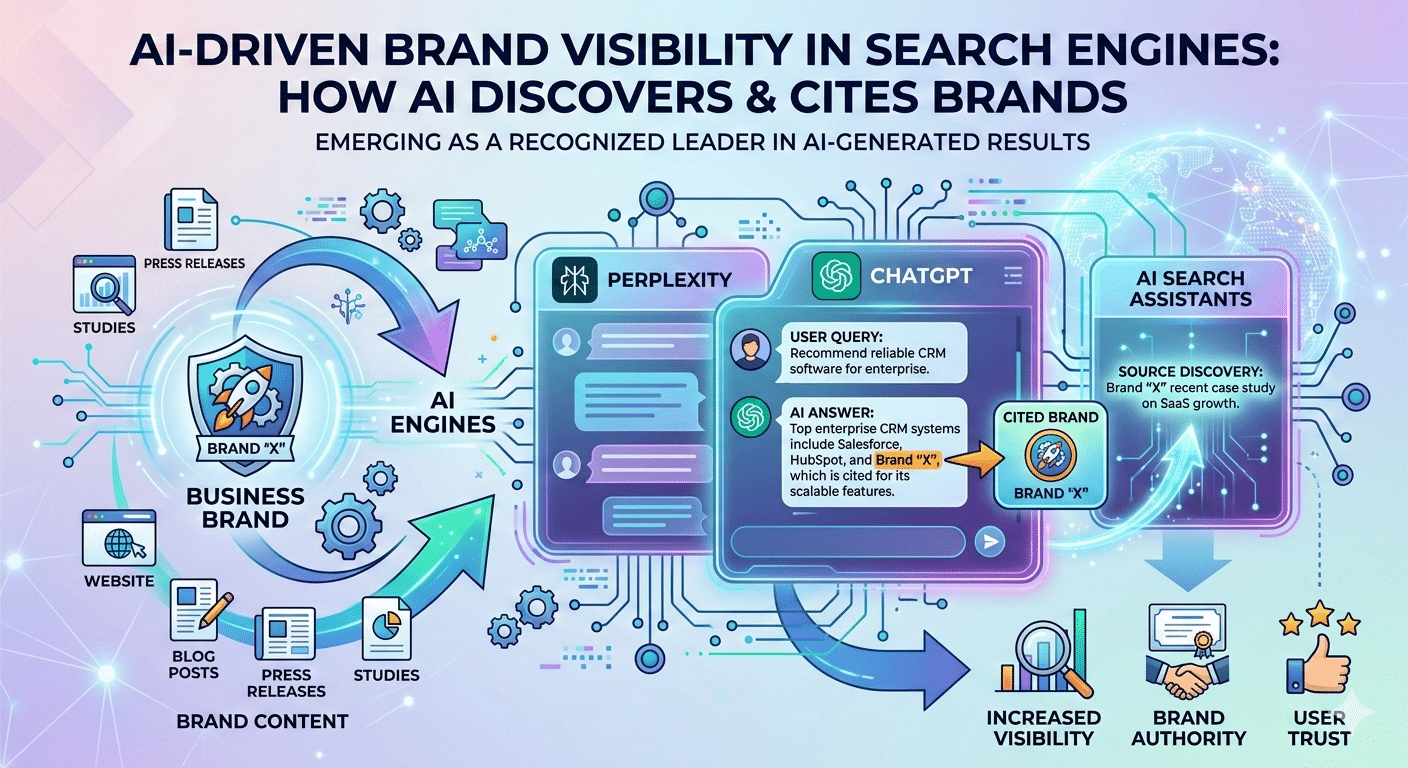
Something changed in search around 2023, and most marketers are still catching up to it.
People used to type queries into Google, scan a list of blue links, and click through to websites. That’s not how a growing slice of search works anymore. Platforms like ChatGPT and Perplexity AI read the question, pull from multiple sources, and write an answer, no blue links, no click required. The source that gets credited isn’t necessarily the one with the most backlinks. It’s the one the AI decided to trust.
That’s a meaningful shift in how brand discovery works. If a buyer asks an AI tool to recommend vendors in your category and your brand doesn’t appear in the answer, you didn’t rank sixth you weren’t in the conversation at all. No impression, no exposure, no chance to earn a click.
The brands that figured this out early are now showing up by default in AI answers for their category. The ones still optimizing exclusively for traditional search are losing visibility they can’t see in their analytics, to a channel they haven’t started building for yet.
This guide covers what AI search visibility actually means, why it matters for your pipeline, and a step-by-step framework for getting your brand cited in AI-generated answers. It also includes a real case study showing how one business went from zero AI visibility to appearing in ChatGPT answers in under two months.
What Is Brand Visibility in AI Search Engines?
Brand visibility in AI search engines refers to how often a company is mentioned, cited, or recommended in AI-generated answers across tools like ChatGPT, Perplexity AI, and other AI assistants.
What that means in practice: In traditional search, visibility is about ranking. A page appears in position one, three, or ten. In AI search, there is no list. The AI writes a response, and your brand either appears inside that response or it doesn’t. You’re either cited or you’re not.
Why it matters: The AI doesn’t rank your homepage. It decides whether your brand is relevant enough, authoritative enough, and structured enough to reference when answering a specific question. That decision happens inside the model, not in a SERP.
Learn more about what AI search visibility is and how it’s measured → AI Search Visibility Definition Guide
Why Does AI Search Visibility Matter for B2B Businesses?
Zero-click discovery is what happens when a buyer gets a complete answer from an AI tool including brand recommendations without visiting any website. The brands named in that answer earn consideration; the ones left out get no exposure at all.
What that means in practice: If a buyer types “best AI SEO agencies” into Perplexity, they get a response that names three or four agencies and explains the recommendation. They might not click through to any of them. But they’ve already formed a shortlist. Your brand either made it or didn’t.
This matters most in B2B, where buyers use AI tools to research vendors before they ever fill out a contact form. Appearing in those AI answers plants your brand at the start of the consideration process before you even know the buyer exists.
Key takeaway: When an AI recommends your brand in response to a specific question, it carries more weight than a paid ad or a ranking in position five. The buyer didn’t find you, an AI they trust to synthesize information found you. That’s a different kind of credibility.
How Do AI Search Engines Decide Which Brands to Recommend?
The AI citation pipeline is the sequence of steps an AI model goes through: from training data to generated answer that determines which brands get mentioned and which don’t. AI models don’t have a ranking algorithm you can reverse-engineer the way you can with Google. But there’s a process, and understanding it is the foundation of everything else in this guide. Read why businesses are invisible in AI?
The AI Citation Pipeline
1. Data ingestion AI models are trained on text from across the web: articles, forums, documentation, reviews, social content. If your brand exists in enough of that training data, the model knows you exist. If it doesn’t, you’re starting from zero.
2. Entity recognition The model needs to understand that your brand is a discrete entity — a company with a specific name, category, and set of attributes. Entity recognition is how AI models distinguish “Ahrefs the SEO tool” from “ahrefs” as a meaningless string of characters. Clear, consistent entity signals across the web make this easier for the model.
3. Topical authority The model associates your brand with subjects. If you’ve published consistently on a topic and trusted sources have mentioned you in that context, the model links your brand with that subject area. You become the go-to name in a particular space not just a company that exists, but a company associated with something specific.
4. Prompt relevance When someone asks an AI a question, the model matches the prompt to entities it associates with relevant topics. If the prompt is “best tools for technical SEO audits,” the model surfaces brands it has connected to technical SEO not SEO in general.
5. Citation selection From the pool of relevant entities, the model selects which ones to actually mention. Factors that influence this include how authoritatively the brand is described in training data, how often it appears across trusted sources, and how well its content aligns with what the prompt is actually asking.
You can influence every step of this pipeline except the first. Data ingestion is historical it reflects the web as it was. Everything else like entity recognition, topical authority, prompt relevance, citation selection responds to what you do now.
7 Factors That Influence AI Search Visibility

AI search visibility factors are the specific signals that AI models use to determine whether a brand is relevant, authoritative, and citation-worthy for a given prompt.
1. Brand entity clarity AI models need an unambiguous picture of what your brand is, what it does, and what category it belongs to. Inconsistent naming, vague descriptions, or muddled positioning across the web makes entity recognition harder and citation probability lower.
2. Topical authority You need depth on specific topics, not broad coverage of your industry. A brand that has published 30 detailed articles on one subject area will be more strongly associated with that area than a brand that has touched 30 different subjects once each.
3. Authoritative mentions When trusted publications industry media, established blogs, academic or trade sources mention your brand in context, AI models register that. These mentions act as votes of contextual authority. This is different from backlinks; the text surrounding your brand name matters, not just the link.
4. Structured content AI models pull from content that’s easy to parse. Definition blocks, clear headers, numbered frameworks, and direct answers to specific questions are more extractable than dense narrative prose.
5. Consistent brand signals Your brand name, category, and core positioning should read the same way across your website, social profiles, press coverage, directories, and third-party mentions. Variation creates noise in entity recognition.
6. Prompt alignment Think about how your prospective customers actually phrase questions to AI tools. If your content doesn’t contain language that maps to those prompts, the model won’t connect your brand to those queries.
7. Knowledge graph presence Entities that appear in structured knowledge sources — Wikipedia, Wikidata, Google’s Knowledge Graph get stronger entity recognition across AI models. Getting your brand into these sources reinforces entity status in a way that ordinary web content can’t replicate.
Key takeaway: Factors 1, 5, and 7 are about being recognized. Factors 2, 3, and 6 are about being relevant. Factor 4 is about being extractable. You need all three to consistently appear in AI answers.
How Can a Business Improve Its Visibility in AI Search Engines?
An AI search visibility framework is a structured approach to optimizing a brand’s presence across the signals that AI models use when selecting citations entity clarity, topical authority, authoritative mentions, and structured content.
The following five-step framework addresses each signal in sequence, starting with the foundation (entity clarity) and building toward citation probability.
Step 1: Establish clear brand entity signals
What to do: Start with your own website. Your homepage, about page, and company description should all define your brand the same way: same name, same category, same core value proposition. Expand that consistency to your social profiles, your Google Business Profile, and any directory listings.
Why it matters: If your brand is described differently across different sources, AI models get conflicting signals. That inconsistency is one of the most common reasons brands with strong SEO metrics still don’t appear in AI answers.
A practical diagnostic: Google your brand name and look at the knowledge panel on the right side of the results. If there’s no panel, or if it describes your brand inaccurately, entity recognition is weak. Fix your Wikidata entry, ensure your company is accurately listed in structured directories, and clean up your schema markup.
The goal is for any AI model processing text about your brand to get the same answer to “what is this company and what does it do?” regardless of which source it reads.
Step 2: Build topical authority clusters
What to do: Pick two or three topics your brand should own. Build depth on each: a cornerstone piece, supporting articles on subtopics, definitions, FAQs, and how-to content. Connect them with internal links so the relationship between pieces is clear.
Why it matters: Broad topic coverage doesn’t generate topical authority. A brand that has written one post on entity SEO, one on GEO, and one on AI search but nothing deeper won’t be strongly associated with any of them.
A topical authority cluster for “AI search visibility” might include a definition article, a guide on entity SEO, a comparison of AI search platforms, a breakdown of how AI models select citations, and platform-specific guides for ChatGPT and Perplexity. Each piece reinforces the others.
Key takeaway: Deep, consistent coverage of a defined subject area earns topical association. Shallow coverage of many subjects doesn’t.
Step 3: Earn mentions from trusted websites
What to do: PR placements, guest content, expert contributions, podcast appearances, the goal is to get your brand name mentioned in trusted sources in context. Not just a backlink, but a sentence that says something meaningful about what your brand does and who it serves.
Why it matters: These mentions feed both topical authority and entity clarity in AI training data. Each contextual mention is evidence for the model that your brand belongs in a particular category.
Think of authoritative mentions as building a body of evidence. The model draws on that evidence every time it generates an answer in your space.
Step 4: Structure content for AI extraction
What to do: Every piece of content should answer a specific question, and it should answer it clearly near the top. Include a definition box for any central concept. Use frameworks and numbered structures when explaining a process. Write in plain language that a model can parse without heavy paraphrasing.
Why it matters: AI models pull sections of content to generate answers. Content that isn’t structured, long narrative paragraphs with no clear entry points is harder to extract from. The same information, organized with a definition and a numbered list, is far more citation-friendly.
The 4 Layers of AI Search Visibility
Use this framework to diagnose where your AI visibility breaks down.
| Layer | What it means | What breaks it |
|---|---|---|
| 1. Discoverability | AI systems can find and process your content | No-index pages, thin content, poor crawlability |
| 2. Entity recognition | AI understands what your brand is and what it does | Inconsistent naming, no structured data, no knowledge graph presence |
| 3. Topical authority | Your brand is associated with a specific subject area | Shallow content, no topical depth, no authoritative mentions |
| 4. Citation probability | AI selects your brand when generating answers | Poor content structure, no definitions, no prompt alignment |
Each layer depends on the one before it. You can’t be cited if you don’t have topical authority. You can’t have topical authority if you don’t have entity recognition. Work down the list. Structure is not about aesthetics. It’s about extractability. A definition box or numbered framework is the part of your content most likely to appear verbatim in an AI answer.
Step 5: Optimize for prompt-driven discovery
What to do: Research how your buyers actually phrase questions to AI tools they’re conversational, specific, and often ask for recommendations or comparisons. Rewrite your section headings as questions. Include direct, clear answers at the top of each section.
Why it matters: AI models frequently extract content that appears directly under a question-formatted heading. “How do companies improve visibility in AI search?” is more likely to trigger a citation than “Strategies for improving AI visibility” because the first matches how buyers actually ask.
Key takeaway: Write for prompts, not just keywords. The language in your headings and opening sentences is what gets matched to conversational queries.
Case Study: How My Business Appeared in ChatGPT Answers in 2 Months
The Challenge
When I started, my site was a fresh domain with no authority. There was no traffic, no backlinks, and no prior visibility in AI search results. Traditional SEO alone wasn’t enough when testing prompts in ChatGPT related to AI search visibility, my brand didn’t appear. Meanwhile, competitors with far less robust optimization were showing up.
Strong SEO was the foundation I needed to even get noticed. Without clean technical SEO, crawlable pages, proper on-page optimization, and foundational link signals, the AI wouldn’t have enough credible data to consider my brand at all.
The problem wasn’t about ranking pages. It was brand entity recognition, structured content, and topical authority, the signals AI uses to decide what to cite.
The Approach
Over eight weeks, I ran a focused, three-pronged strategy aimed at getting recognized by AI models as a credible source.
Step 1 Topical authority
I chose the most relevant topics for my brand: AI search visibility and generative engine optimization. For each, I built content clusters:
- One cornerstone article
- 4–6 supporting articles
- FAQ sections written to match conversational prompts
Step 2 Structured, extractable content
I rewrote key pages to make them AI-friendly:
- Definition boxes for core concepts
- Numbered frameworks for processes
- Clear answers in the first 150 words of each section
- Removed filler content that made extraction harder
Step 3 Entity clarity
I standardized every description of my brand across:
- Website pages
- Social profiles
- Directories and media mentions
The Prompts I Tested
I tracked these prompts weekly to measure progress in ChatGPT:
- “Recommend affordable service-based businesses that do AI search visibility optimization”
- “Who offers hands-on AI search visibility optimization services?”
- “Who offers hands-on AI search visibility services?”
The Results
- Week 1: Zero mentions — expected for a fresh domain.
- Week 4: Weak, Partial mentions on some content was starting to get recognized.
- Week 8: The prompts returned my brand. ChatGPT not only mentioned my business but contextualized it correctly, showing it had registered my topical authority and entity signals.
Key takeaway: entity clarity and structured content were the highest-leverage actions. Without consistent brand signals and AI-friendly content, building topical authority alone wouldn’t have produced results.

Lessons Learned
- Strong SEO is the foundation: Technical SEO, clean on-page optimization, crawlable pages, and credible link signals are the prerequisite for AI recognition.
- Start with entity clarity: Make sure AI models can unambiguously recognize your brand.
- Build deep topical clusters, not shallow posts: Focused, high-quality content beats lots of thin content.
- Structure for extraction: Definition boxes, numbered frameworks, and concise answers increase the chance of being cited.
- Test prompts constantly: Use real buyer-style prompts to measure progress and guide content creation.
- Use external mentions strategically: Trusted sources, structured knowledge entries, and relevant media coverage accelerate AI recognition.
The AI doesn’t rank pages, it ranks brands. Starting with strong SEO ensures your foundation is solid, but entity clarity, topical authority, and structured content are what get your brand cited.
Traditional SEO vs AI Search Optimization
The two approaches aren’t in conflict, but the optimization logic is fundamentally different. Google rewards pages. AI rewards brands.
How they handle authority
| Signal | Traditional SEO | AI Search Optimization |
|---|---|---|
| Primary authority signal | Backlinks | Entity authority + topical association |
| What gets evaluated | Individual pages | Brand as a whole entity |
| Where authority is built | Link profile | Training data, mentions, knowledge graph |
How they handle discovery
| Signal | Traditional SEO | AI Search Optimization |
|---|---|---|
| Discovery mechanism | Keyword match → ranked list | Prompt match → generated answer |
| User action required | Click through from SERP | Brand exposure happens before any click |
| Measurement | Rankings, impressions, CTR | Prompt-testing, citation tracking |
How they handle content
| Signal | Traditional SEO | AI Search Optimization |
|---|---|---|
| Content goal | Match keyword intent | Answer the prompt directly |
| Formatting priority | Readability, on-page SEO | Extractability, definition blocks, frameworks |
| Optimization level | Page-level | Brand-level entity and authority |
Strong traditional SEO still helps, pages with authority are more likely to appear in training data and more likely to be cited. But doing only traditional SEO while ignoring entity signals and content structure leaves a growing share of brand discovery unaddressed.
How Does AI Visibility Generate Leads?
AI-driven lead generation is what happens when a buyer’s research phase: vendor discovery, shortlisting, initial evaluation takes place inside AI tools rather than through search engines or direct website visits.
Buyers use AI tools to research options and build shortlists before they’re in an active buying process. When your brand appears in those AI answers, you get considered before you even know the buyer exists. They arrive on your site already familiar with your name, already having seen a description of what you do.
That’s different from someone who found you by clicking on a ranking article. The AI pre-qualified them. The research phase happened somewhere else, and you were part of it.
Traditional attribution models miss this entirely. If a buyer researched you in ChatGPT and came to your site directly three days later, the AI citation doesn’t show up in your analytics it looks like direct traffic. Measuring AI visibility requires prompt-testing, not just traffic analysis. Buyers who arrive via AI recommendation tend to convert faster, because they’ve already absorbed context about your brand before their first visit.
See our step-by-step process → B2B AI Visibility Pipeline
Common Mistakes That Prevent AI Visibility
Relying only on backlinks. Link authority is still relevant, but it doesn’t translate directly into AI citation authority. AI models don’t process your backlink profile they process the text they were trained on. What matters is how your brand is described in that text, not how many sites link to you.
Thin content. Short posts that skim a topic aren’t citation material. AI models cite sources that go deep on specific questions. This is where AI search optimization diverges from traditional content strategies that prioritized quantity over depth.
Inconsistent brand identity. If your brand is described differently across your site, social profiles, third-party listings, and press mentions, the model gets conflicting signals. This is especially common in companies that have rebranded the old identity lingers across the web and creates noise in entity recognition.
Ignoring entity SEO. Most brands have never thought about their presence in Wikipedia, Wikidata, or structured knowledge sources. For AI visibility, that’s the equivalent of not having a website in 2010. Entity presence in structured sources is a foundation layer, not an optional extra.
Writing for keywords instead of prompts. Traditional SEO content is written to match short keyword queries. AI search is driven by conversational prompts: longer, more specific, often asking for recommendations or comparisons. Content that doesn’t include the language patterns buyers use when talking to AI tools won’t match those prompts, regardless of its keyword optimization.
The Future of AI Search Visibility
The shift is still early. ChatGPT and Perplexity AI are the names most people associate with AI search right now, but the surface area is expanding. AI is getting embedded into browsers, operating systems, customer service flows, and enterprise tools. Every one of those surfaces is a potential citation opportunity or a gap.
Conversational search is becoming the default for a growing audience. Younger users are more likely to ask an AI than to run a Google search. As that behavior normalizes, the brands that invested in AI visibility early will have a compounding advantage. The model’s training data reflects the web as it existed; brands that built a strong, consistent presence now will benefit from that for years. AI recommendation engines are expanding. Platforms are building explicit recommendation layers AI-suggested results inside product searches, booking flows, and service directories. The logic powering those recommendations draws on the same signals as AI search: entity clarity, topical authority, authoritative mentions.
AI-driven discovery reduces reliance on active search intent. Traditional SEO captures buyers when they’re actively searching. AI search can surface your brand earlier, before a buyer has even formulated a search intent. Brand building and content strategy are no longer separate disciplines getting your brand into AI answers requires both. Agent-based interfaces change the stakes. As AI agents take on more research tasks on behalf of users, which brands get recommended becomes even more critical. An AI agent tasked with finding the best vendor for a service isn’t going to present ten options it’s going to recommend one or two. Being one of those recommendations will matter more than any search ranking.
The brands that build entity clarity, topical authority, and prompt-friendly content now will show up in AI answers as default recommendations. The ones that don’t will spend the next few years watching their traffic decline without a clear explanation.
Conclusion
AI search visibility is becoming a core marketing strategy, not a niche experiment. It’s not a replacement for SEO, but it’s a different game with different rules and brands that treat it like traditional SEO will miss most of what matters.
Start with an audit: test your brand against the prompts your buyers are actually using, see where you appear and where you don’t, and use that to build a priority list. Run an AI visibility audit → AI Visibility Audit
From there, build topical authority in the areas where you want to be cited, clean up your entity signals, and structure your content so AI models can actually extract and use. Implement these strategies with guided AI Visibility Framework – Blueprint.
The window to get ahead of this is still open.
FAQs
How long does it take for AI to start citing my brand?
Results vary, but consistent entity clarity, structured content, and topical authority often show initial citations within 6–8 weeks, as shown in case study.
Do backlinks influence AI citations?
Indirectly. They increase exposure in the AI’s training data, but AI visibility primarily depends on entity recognition, topical authority, and structured content.
What types of content do AI models prefer for citations?
Definition blocks, numbered frameworks, FAQs, and clear, concise answers near the top of pages.
Can small websites compete for AI visibility?
Yes. Small sites with focused topical clusters, clear entity signals, and prompt-aligned content can gain citations even with lower domain authority.
How do I measure AI visibility?
Through prompt testing — track where your brand appears for relevant questions on ChatGPT, Perplexity, and other AI platforms.
Leave a Reply